Hadrian’s Wall Relief Prints — Progress Update
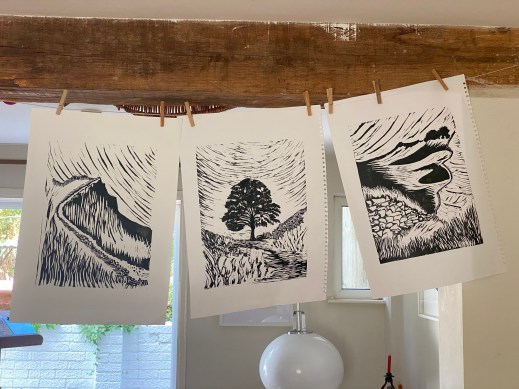
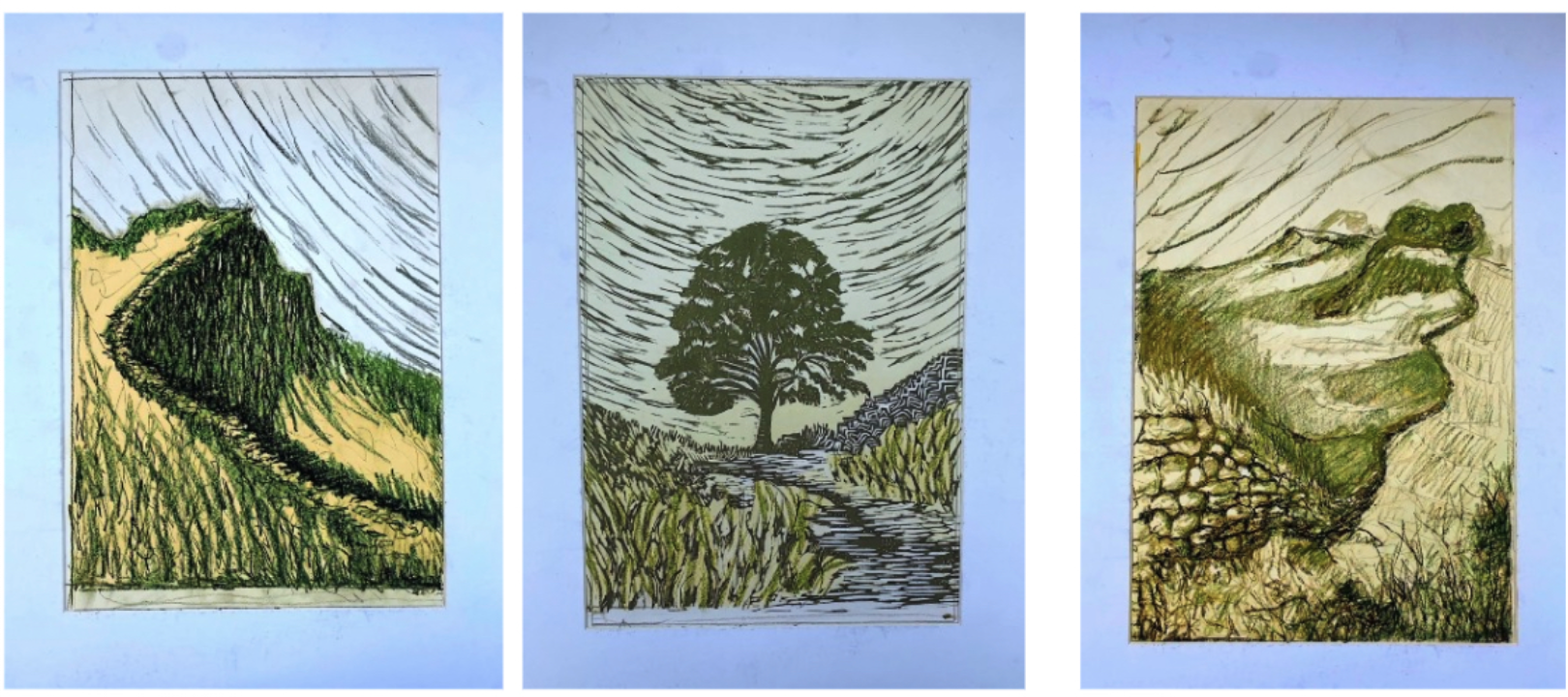
This new set of three relief prints began as a simple idea: to create companion pieces to my earlier Sycamore Gap print. I wanted to explore other views along Hadrian’s Wall — perspectives that would complement that iconic scene while standing on their own.
I’m tempted to try a block where I have cut the Sycamore Tree out, or leave it to turn it into a ‘ghost tree’ …
The journey so far:
We were staying in Northumberland three weeks ago. We rented a cottage from the Belsay Estate, a lovely isolated Northumberland farmhouse surrounded by a shelter belt of veteran Ash tress, in field, down a track through a field. It should be inspiration for drawings and prints galore. Similarly St Andrews, a Saxon Tower and 13th Century Church. I went there with the purpose of sketching out a print marrying the old stone work and structure with two huge sycamore trees behind it, one with a girth of 5.7m likely to be upwards of 200 years old.
We came home to Sussex via the Military Road, parallel to Hadrian’s Wall. I’m Northumberland born and bred, educated at Mowden Hall (Newton, nr Stocksfield) and then the other side of the Pennines at Sedbergh, so I know this road, and the roads east to west well. This is my favourite route; I rarely take the A69 unless time is of the essence, and depending on my destination, the over-the-top route via Alston is a worthwhile trip.
The sycamore gap is no more; it is now just another dip against the skyline. It fascinates me how we mourn a lone sycamore tree, not a very old one, not worth a mention in something like the Woodland Trust Ancient Tree Inventory, which I have been working on as a Woodland Trust Volunteer Tree Surveyor for a couple of years.
The idea of three pictures, or a Triptych, came as a result of a call from The Depot, here in Lewes, asking artists to submit ideas for Artwave this September on the theme of ‘Structure’. I like the idea of how Hadrian‘’’s Wall could stitch together multiple prints. I could add more, but the entrance fee and guidelines stipulate three entries. I suppose if I hung the two outer pictures against the central one, that would be a single entry.
This is my first doodle. It’s what I refer back to still, the intent to capture a sense of the rollercoaster that is Hadrian‘’’s Wall, and the Military Road.

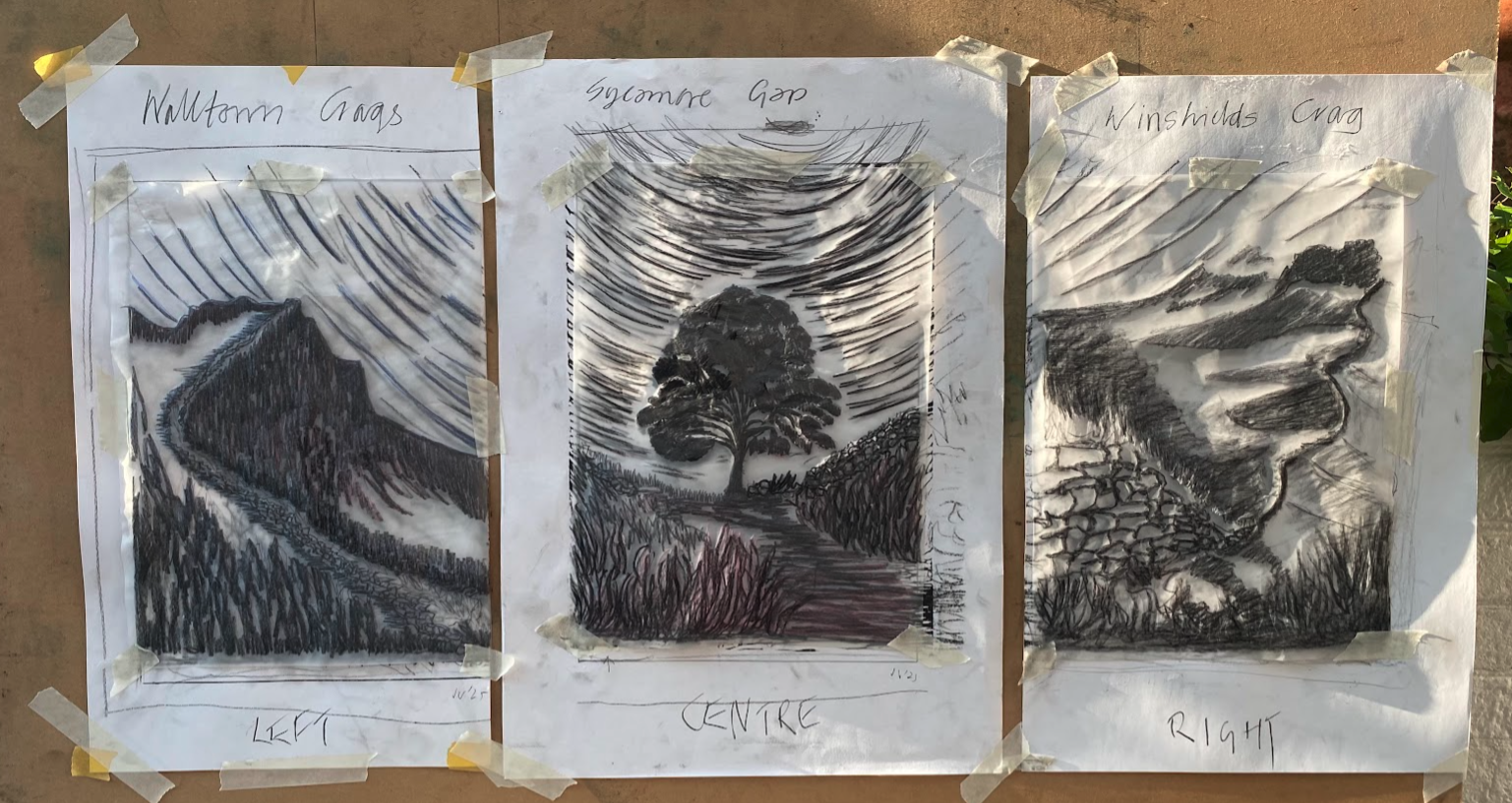
First ideas — settling on viewpoints that would balance drama, history, and landscape. Scamps — quick sketches to explore layout and composition.
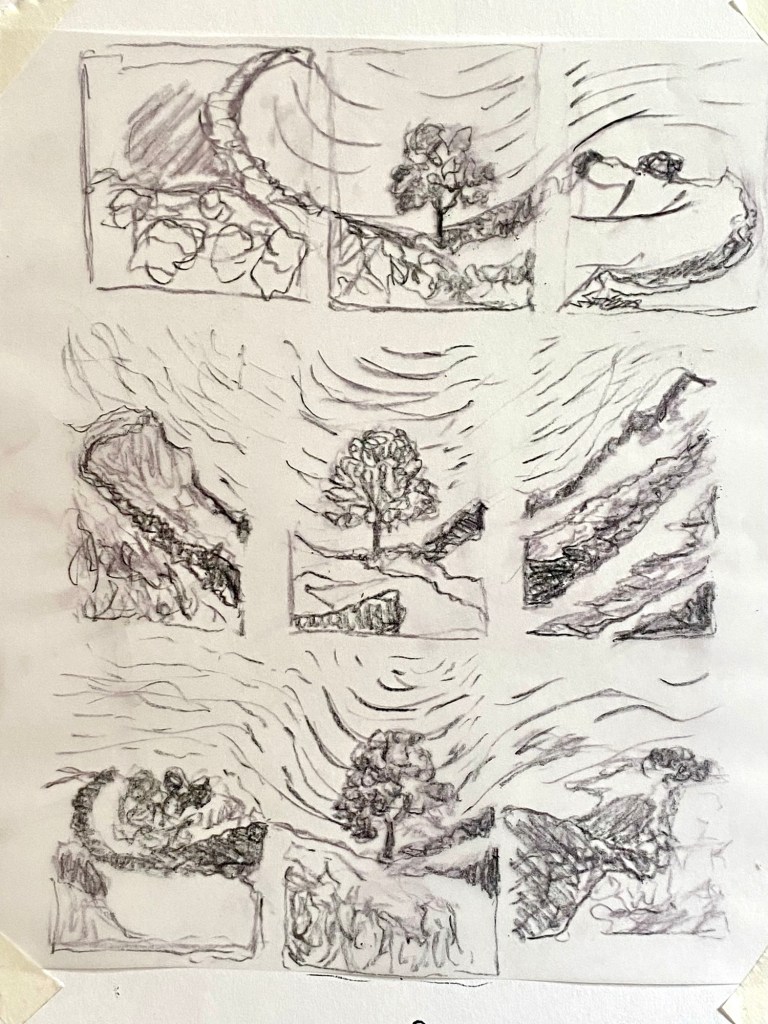
Drawings to size — refining each image so it would fit comfortably onto a prepared block.
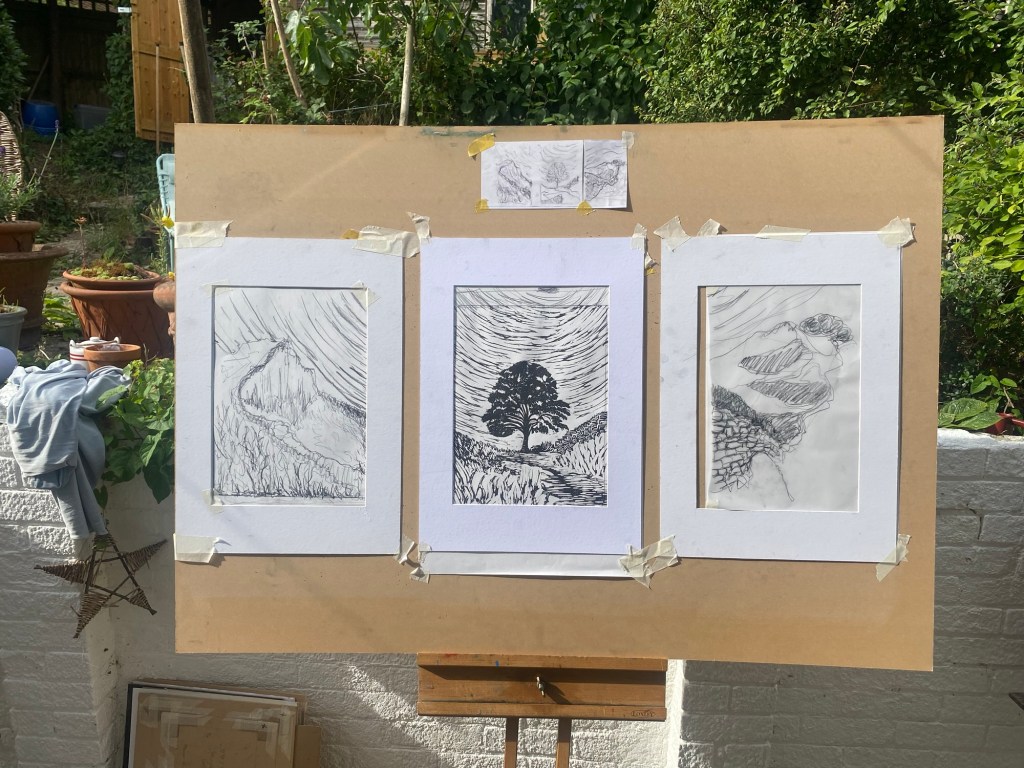
Block preparation — Lino sheets glued to 3 mm MDF for stability.
Experimentation — playing with how the wall, sky, and land might interact in carved form.

Tracing paper versions — to check proportions and guide the transfer. Transfer to lino — reversing the drawings for carving.

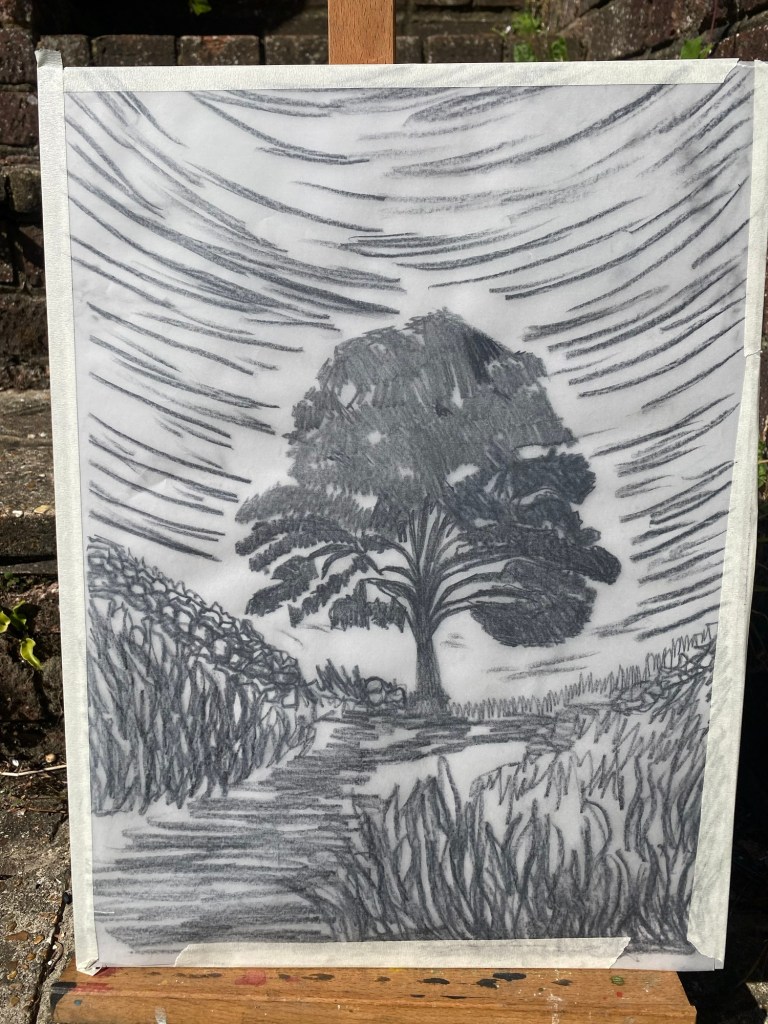
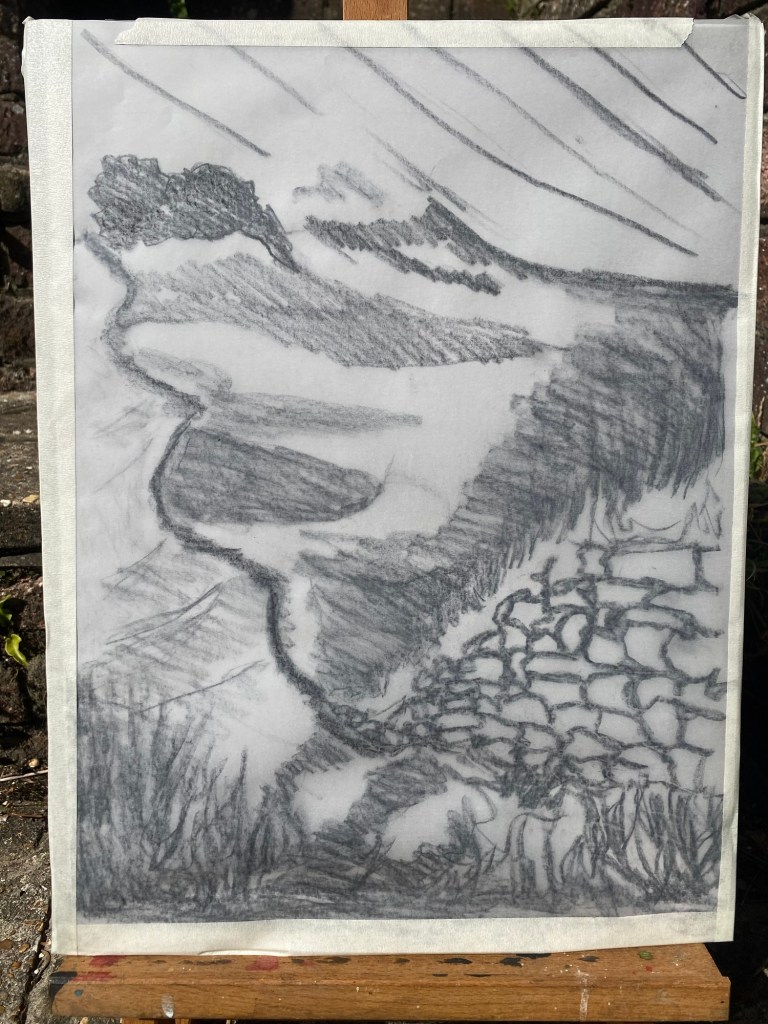
Once etched onto the Lino block by marking over these pencil drawings (always 6B soft pencils or charcoal pencils) I was intrigued by the impression made on the tracing paper, which in the low evening sun gave a 3D effect across the drawing board.
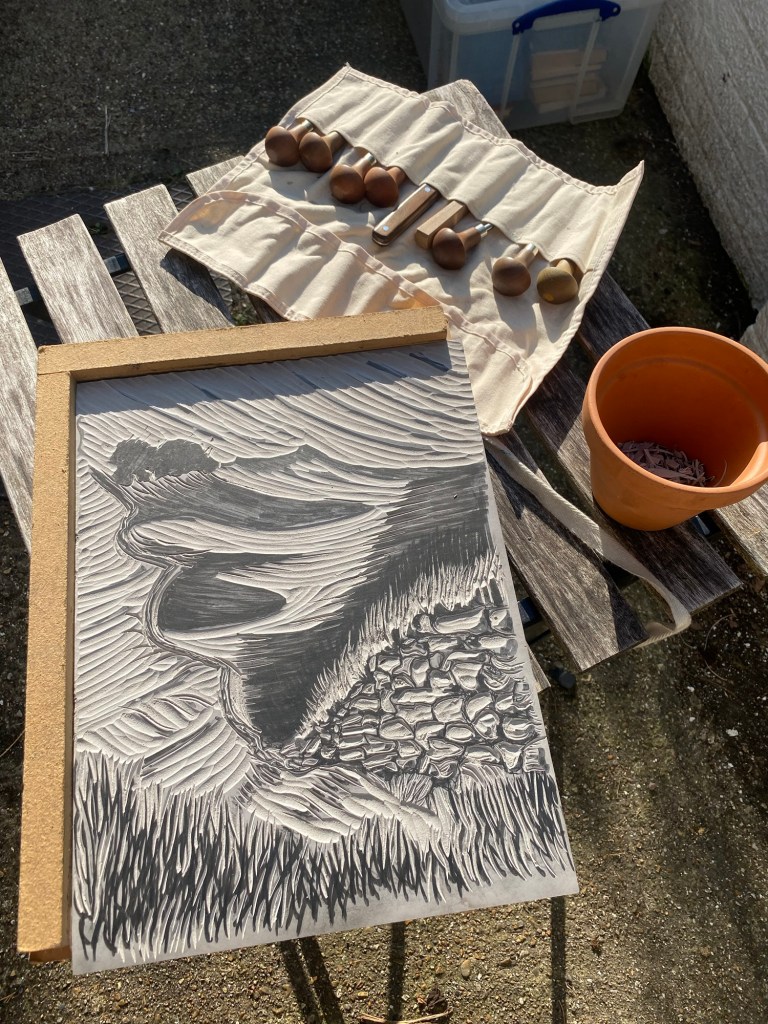
Cutting — slowly bringing each design to life, line by line.
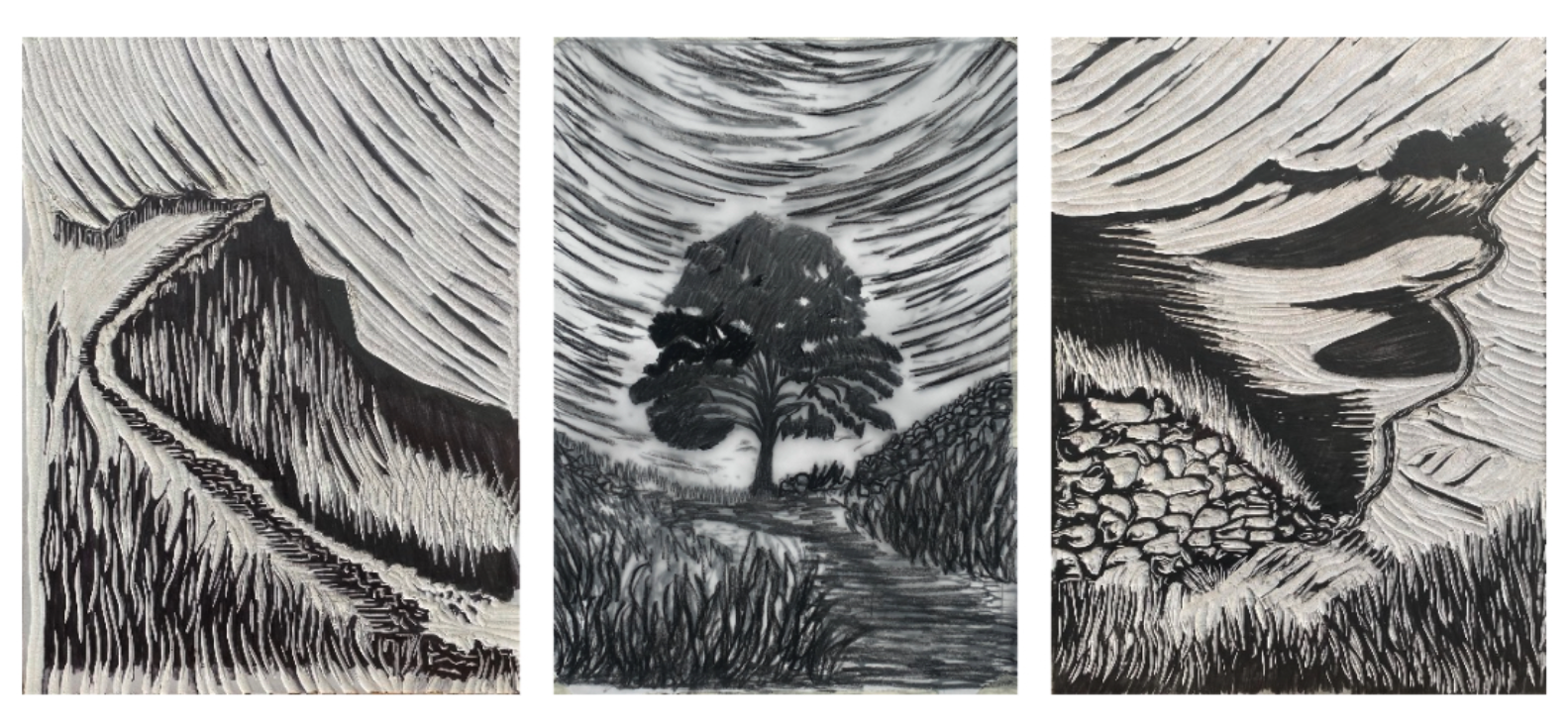
Test prints — first hand prints in Payne’s Grey on cartridge paper to reveal where the carving works and where it needs refinement.

From here, the plan is to fine-tune the carving, explore colour layers, and print onto archival paper. I’m also editing a short 30-second video showing the whole process — from first sketch to finished print — which I’ll share soon across Facebook and Instagram.
I don’t hesitate to drop photos of my work, at different stages of progress, into Geni GPT to create mock ups of what I am doing. It has not got the idea of Chin Collée at all; I suppose it would need exact paper sizes, cut positions. What I may do is use Adobe to do this in several layers. When I get to adding colour I’ll try different coloured papers and cuts, and then make a cardboard stencil so that I can cut a dozen pieces of each colour to the same shape and size. This can become baffling, so I mark up the stencil and keep all the pieces in separate trays.
I’ll walk all of Hadrian’s Wall one day – rather than doing it in bits over decades. Sketch book always to hand.
I’ll refine the cut in the next day or so, then print again. From a ghost print, I’ll then pick colours, likely to be moss green, light green and straw yellow. I may use a mottled handmade white/beige paper that can add to the stone effect (I used it on my Lewes Castle print).

Sycamore Gap Print: Iconic Tree Art Inspired by Hadrian’s Wall
After seven years of life drawing, I have turned my attention to trees, starting with sketches of veteran trees in Markstakes Common. This project, which began as an effort to identify trees recognised in a 2010/11 survey, evolved into large pen-and-ink illustrations and prints.
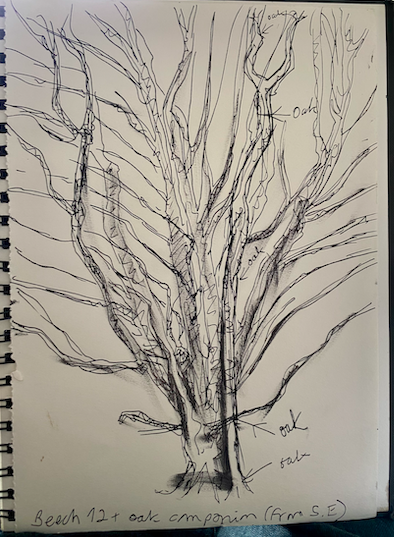
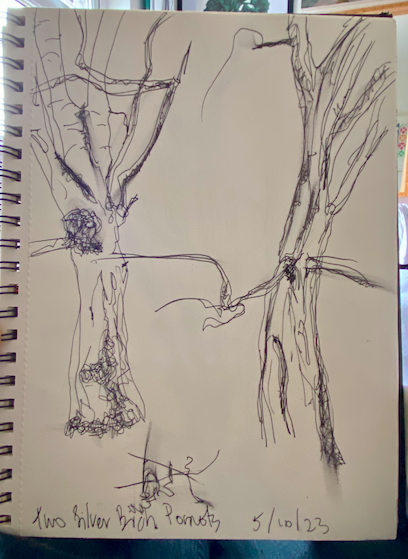

When the iconic Sycamore Gap tree on Hadrian’s Wall was cut down in 2023, it became an inevitable subject for my art. Northumberland, the county of my birth, has always been a significant inspiration. Growing up, I frequently visited Hadrian’s Wall, attending Mowden Hall, a boarding school near Corbridge. We spent our lives in the countryside and then later, often driving between Northumberland and Cumbria, taking the scenic military road which runs parallel to the Wall.
In my quest for reference photos, I turned to my sister, who lives in Northumberland. She took pictures during a family gathering in July 2019. These images have inspired a new series of hand-printed A3 chine collée lino prints, capturing the essence of the Sycamore Gap tree.
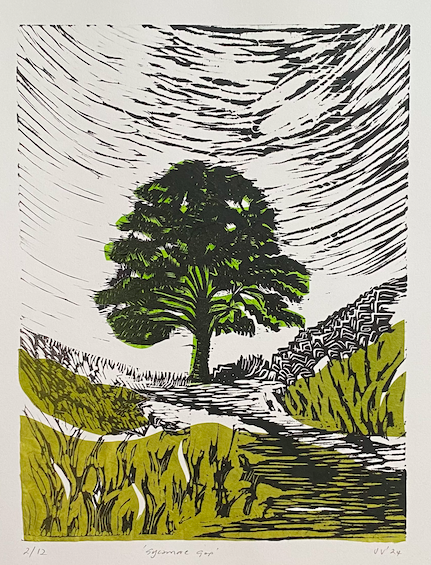
Explore the Sycamore Gap Print collection to own a piece of this iconic landscape, intricately detailed and rooted in personal history and regional heritage.
 JV Art